
ABOUT HOW TO CHOOSE YOUR FINISH
- Where can Clay Plasters suitable be applied?
- Clay plasters are suitable for interior walls, ceilings. They are ideal for bathrooms and kitchen (place will makes moisture during human activities, such as bathing and cooking), but not wet areas (do not continue splashed by water). They can be applied onto most sub-surfaces, learn more on each product application sheets.
- Why breathable is important to buildings?
- Buildings receive moisture from many different sources. If a non-breathing finish is used, the moisture will remain trapped in walls, causing damp and decay, and reducing the ability of the walls to insulate. This process can happen in reverse when the external temperatures are warmer than the internal ones, especially when air conditioning is used.
- How does Clay Plasters work?
- Clay Plaster is hygroscopic, able to regulate moisture within a building. They share the fundamental characteristic of being highly vapour-permeable (‘breathing’/porous), thus allowing the unimpeded passage of water vapour through their pores. Cement has low vapour-permeability, therefore unable to respond appropriately to moisture within a building.
- Are there any benefits of applying Clay Plasters indoors?
- Clay Plaster have the knock-on effect of enhancing indoor air quality and hence human health, can improve indoor comfort environment, as well as being less harmful to the environment (their production, toxicity and ease of disposal), and improving the look and general ‘feel’ of the spaces.
- Can Clay Plasters be used outside?
- Clay Plasters have the functions of regulating moisture and enhancing indoor air quality, therefore mainly used indoors. If used outside, you must be covered with rain cover or eaves.
- How can Clay Plaster apply in modern life?
- Please browse our website to learn more case studies. Feel free to share with us reference pictures and ideas, we are happy to discuss any questions.
References: Bryce, Katy; Weismann, Adam. Clay and lime renders, plasters and paints. UIT Cambridge Ltd.. Kindle Edition.
ABOUT HOW TO INSTALL
- What kind of substrate can apply Clay Plasters directly?
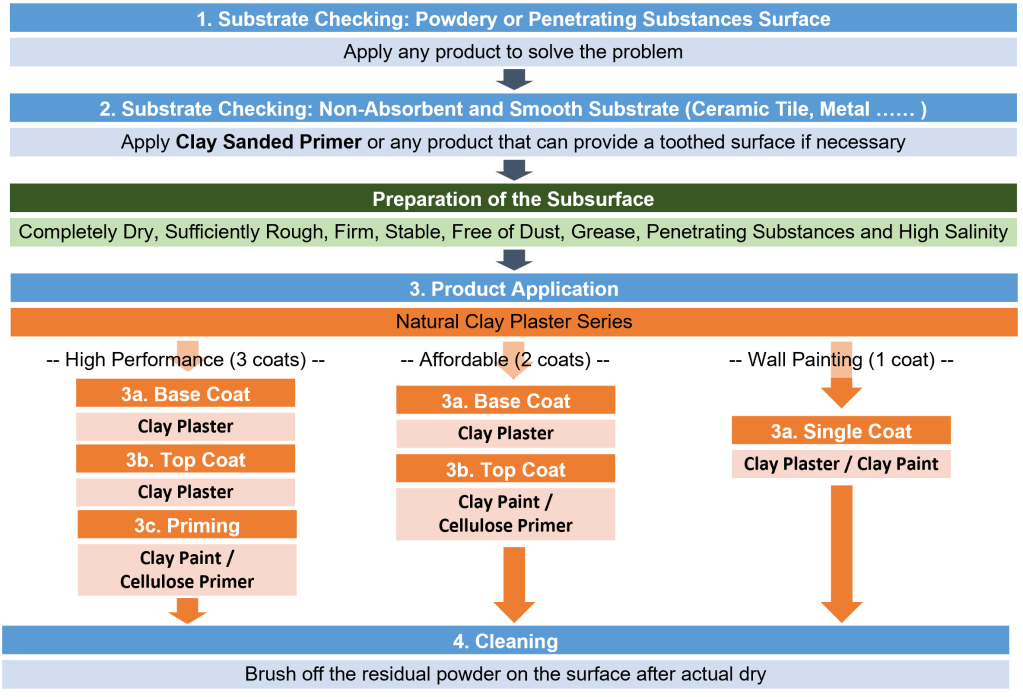
- The substrate should be completely dry, sufficiently rough, firm, stable, clean, dust-free, free of grease and penetrating substances. Permanent moisture or high salinity must be prevented. Loose or flaking material (such as loose paint) must be removed.
- For smooth or non-absorbent substrate, such as plywood or ceramic tile, we suggest applying Clay Sanded Primer (if necessary) or other products that can provide a toothed surface before applying Clay Plasters.
- For highly absorbent substrate, such as plasterboard must be fully moistened before the application or apply Clay Sanded Primer (if necessary) to prevent Clay Plaster dry too quickly and create a clear boundary.
- If the Clay Plaster finishes more than 5mm thickness, Glass-fibre mesh should be embedded into the Clay Plaster to prevent cracking.
- We strongly recommend creating a test sample area before applying! The test area is used to check the subsurface condition and colour results.
- Our Clay Plaster is reversible, so don’t worry about doing it badly, you can easily scrap off after moisture it if necessary. Keep practising and creating, there are a lot of fun in it! Don’t forget to share all the time!
ABOUT ORDERING
Let us know the installation area in meters square/square feet and the chosen finish, and we will send a quote. We are happy to discuss any questions.
Contact Number: 011-1185 7504 (Mr.Tang)
E-mail: gnihomeplester@gmail.com
Location : 19, Jalan SS 2/101, 47300 Petaling Jaya, Selangor Darul Ehsan, Malaysia.
 GNIHOME CLAY PLASTER ENTERPRISE